Skip to content

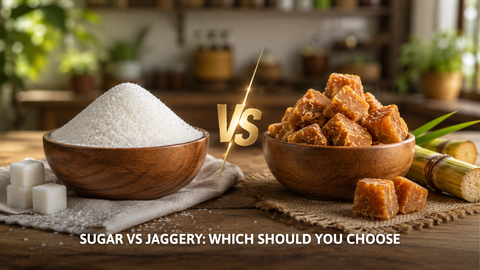
Walk into any modern pantry, and you will likely find two distinct sweeteners sitting side by side: refined white sugar crystals and traditional golden-brown jaggery (Gud). While both originate from natural plant juices like sugarcane, the massive gap in how they are made, digested, and absorbed by your body sparks an ongoing debate: in the battle of sugar vs jaggery, which sweetener truly reigns supreme for long-term health?
Understanding the primary difference between jaggery and sugar is essential if you want to eliminate empty calories, optimise your daily digestion, and choose natural sweeteners that support your family's overall wellness. This comprehensive guide breaks down how both sweeteners are processed, analyses their nutritional profiles, compares alternatives like coconut sugar vs jaggery, and answers the age-old question: jaggery or sugar, which is better?
Understanding Sugar and Jaggery: Processing and Extraction
To evaluate how jaggery is better than sugar, we must first examine how both sweeteners are extracted from sugarcane juice (Ganne ka Ras) or sap.
-
Extraction & Processing Flow:
- Chemical Refining & Sulfur Bleaching Refined White Sugar (~99.9% Pure Sucrose, Zero Nutrients)
- Slow Boiling & Traditional Clarification Organic Unrefined Jaggery (Rich in Molasses & Minerals)Sugarcane Juice / Sap
1. The Industrial Refined Sugar Process
Industrial white sugar production prioritises rapid crystallisation, bright visual uniform white colour, and indefinite shelf-life over nutritional retention.
- Extraction & Clarification: Sugarcane juice is extracted and treated with chemical agents like sulfur dioxide, phosphoric acid, and calcium hydroxide to strip impurities and bleach the liquid.
- Boiling & Evaporation: The juice is boiled at intense high temperatures under a vacuum until heavy sucrose crystals form.
- Centrifugation & Washing: The crystallised mixture is spun in high-speed industrial centrifuges to completely separate the dark, nutrient-dense molasses layer from the sugar crystals.
- Recrystallisation: The raw sugar is melted, filtered through bone char or activated carbon, and recrystallised into spark-clean, 99.9% pure sucrose granules.
The Result: Highly refined white granules providing short-lived, immediate caloric energy completely stripped of natural vitamins, minerals, and dietary fibres.

2. The Traditional Jaggery Process (Bilona / Craft Method)
Traditional jaggery (Gud) production relies on time-tested, chemical-free methods that preserve plant-based nutrients.
- Boiling in Iron Vessels: Fresh sugarcane juice or palm sap is poured into wide, heavy iron pans (Kadhai) and boiled slowly over firewood.
- Natural Clarification: Instead of chemical sulfur, natural plant-based clarifiers (such as okra/bhindi plant extracts or herbal enzymes) are stirred in to float surface impurities, which are skimmed off manually.
- Concentration & Cooling: The liquid concentrates into a rich, caramel-like slurry without stripping away the natural molasses. It is then poured into moulds to solidify into blocks or pulverised into granular jaggery powder.
The Result: Unrefined, mineral-rich sugar and jaggery alternative that preserves the natural dark colour, deep earthy flavour, essential iron, and trace micronutrients of the original plant.

Key Differences: Sugar and Jaggery Difference Breakdown
Examining the core parameters behind the sugar and jaggery difference highlights why unrefined choices outperform refined white granules:
| Quality Parameter | Refined White Sugar | Traditional Sugarcane Jaggery (Gud) |
| Processing Method | Heavy industrial refining, sulfur bleaching, chemical crystallisation | Minimal processing, slow boiling in iron vessels, zero chemical bleaching |
| Molasses Content | Completely removed during high-speed centrifugation | 100% retained, providing rich caramel flavour and colour |
| Nutritional Value | "Empty calories" (~99.9% pure sucrose with no micronutrients) | Rich in Iron, Potassium, Magnesium, Phosphorus, and B-vitamins |
| Digestion Speed | Rapidly absorbed; triggers sharp blood sugar and insulin spikes | Complex sucrose chains digest gradually, offering sustained energy release |
| Body Thermal Effect | Considered cooling (Sheetal) in traditional Ayurveda | Considered warming (Ushna), stimulating metabolic heat and immunity |
| Effect on Digestion | Offers no digestive benefits; can disrupt gut flora balance | Stimulates digestive enzymes, prevents constipation, and cleanses lungs/liver |
Jaggery or Sugar: Which Is Better? Health Benefits of Jaggery
From a clinical and Ayurvedic perspective, asking how jaggery is better than sugar comes down to nutritional density and body function support.
1. Rich Source of Essential Minerals and Iron
Because jaggery retains natural molasses and is traditionally boiled in iron woks, it gathers significant concentrations of ferrous salts (iron) and folate. Consuming unrefined jaggery daily helps boost haemoglobin production, fight fatigue, and protect against iron-deficiency anaemia, especially in women and growing children. Refined white sugar offers zero minerals.
2. Sustained Energy vs. Sudden Energy Spikes
Refined white sugar consists of short-chain simple sugars that enter the bloodstream almost instantaneously. This triggers rapid blood glucose spikes followed by an immediate energy crash, leading to fatigue and intense sugar cravings. In contrast, jaggery contains complex sucrose chains that break down slowly during digestion, supplying sustained, long-lasting energy.
3. Digestive Health and Enzyme Activation
Consuming a small piece of jaggery after meals is a time-honoured Indian tradition for good reason. Jaggery stimulates the secretion of digestive enzymes in the stomach, speeding up food breakdown, reducing bloating, and preventing chronic constipation. White sugar, conversely, provides no digestive support and can trigger acidity or metabolic sluggishness.
4. Respiratory & Systemic Detoxification
Jaggery acts as a natural cleansing agent for the body. Studies show that jaggery helps trap and clear dust particles, soot, and pollutants from the respiratory tract, lungs, food pipe, and stomach. It is frequently recommended for individuals living or working in heavily polluted urban environments.
Coconut Sugar vs Jaggery: Which Natural Sweetener Is Right For You?
As health-conscious consumers look beyond white sugar, comparisons between coconut sugar vs jaggery have become increasingly popular.
Natural Sweetener Glycemic Spectrum:
- Refined White Sugar: High GI (~65-70) | Highly Refined & Chemical Processed
- Sugarcane Jaggery: High GI (~84) | Minimal Processed | Rich in Iron, Potassium & Molasses
- Coconut Sugar / Palm Jaggery: Low GI (~35-54) | Unrefined | Rich in Inulin Prebiotic Fiber & Minerals
What is Coconut Sugar?
Coconut sugar is harvested from the sap of flower buds on the coconut palm tree. The sap is heated gently until moisture evaporates, leaving behind brown, caramel-flavoured granules.

Comparing Coconut Sugar vs Jaggery
- Glycemic Index (GI): Coconut sugar has a lower Glycemic Index (~35-54) than sugarcane jaggery (GI ~84) and refined sugar (GI ~65-70). This lower GI is due to inulin, a natural prebiotic fibre found in coconut palm sap, which slows glucose absorption.
- Mineral & Antioxidant Profile: Both options are unrefined and rich in trace minerals. While sugarcane jaggery is exceptionally high in iron and potassium, coconut sugar excels in zinc, calcium, potassium, and active polyphenols.
- Flavour & Culinary Use: Sugarcane jaggery offers a deep, earthy, molasses flavour ideal for traditional Indian sweets (Kheer, Laddoo, Payasam). Coconut sugar provides a mild, light caramel flavour that easily replaces white or brown sugar 1:1 in Western baking, coffee, and everyday beverages.
Sugar and Jaggery for Diabetics: Setting the Record Straight
A widespread myth claims that switching from sugar to jaggery makes desserts completely safe for individuals living with diabetes.
The Reality: While jaggery is nutritionally superior to white sugar because of its mineral content, it is still sugar. Sugarcane jaggery contains roughly 65-85% sucrose and fructose, carries a high glycemic index, and contains roughly the same caloric density (~38 calories per tablespoon) as white sugar.
While jaggery releases glucose slightly more gradually than refined white sugar, it will still raise blood glucose levels. Diabetics should treat jaggery with the same caution as white sugar and consume it only in strict moderation after consulting their physician.
How to Choose Pure, Chemical-Free Jaggery at Home
When purchasing jaggery, avoiding chemically treated varieties is critical to securing its true health benefits.
- Check the Colour: Avoid unnaturally bright yellow or pale golden jaggery blocks. Bright colours usually indicate the addition of artificial food dyes, sodium hydrosulfite, or sulfur bleaching agents. Choose dark brown, dark amber, or deep reddish-brown jaggery.
- Check the Taste: Pure organic jaggery tastes deep, sweet, and caramel-like. If you taste a faint saltiness, bitterness, or chemical aftertaste, it indicates added mineral salts, chalk, or commercial preservatives.
- Check the Hardness: Pure, unadulterated jaggery is slightly soft, moist, and easy to break by hand. Unnaturally hard, glassy blocks often contain added sugar syrups to increase weight and firmness.

Conclusion
By understanding the key points behind sugar vs jaggery, recognising the differences between coconut sugar vs jaggery, and knowing how jaggery is better than sugar, you can make conscious, health-focused choices for your daily diet. Replacing heavily refined, chemically bleached white sugar with authentic, unrefined organic jaggery ensures that every sweet bite nourishes your body with vital minerals, steady energy, and rich traditional flavour.
FAQs
Q1. Is jaggery better than sugar for daily consumption?
Yes, jaggery is generally a better choice than refined sugar because it contains essential minerals like iron and potassium. While both provide calories, jaggery offers sustained energy and aids digestion rather than causing sudden blood sugar spikes.
Q2. Can diabetics replace sugar with jaggery safely?
Diabetics should consume jaggery with the same caution as white sugar. Although it is unrefined and contains minerals, jaggery still has a high glycemic index and will raise blood glucose levels significantly.
Q3. What is the main difference between coconut sugar and jaggery?
Coconut sugar is made from coconut palm sap and has a lower glycemic index, while traditional jaggery is made from sugarcane juice and is richer in iron. Both are excellent unrefined alternatives to white sugar.
Q4. Does jaggery help in weight loss compared to sugar?
Jaggery can support weight loss slightly better than white sugar because it boosts metabolism and helps prevent water retention. However, it is still high in calories and must be consumed in strict moderation.
Q5. How can I identify pure and chemical-free jaggery?
You can identify pure jaggery by its dark brown or deep reddish colour. Avoid bright yellow blocks, as they often indicate the addition of artificial colours and chemical bleaching agents used during commercial processing.
Q6. Why is jaggery considered good for digestion?
Eating a small piece of jaggery after meals helps stimulate the release of digestive enzymes in the stomach. This natural process speeds up food breakdown and helps prevent issues like bloating and constipation.
Q7. Does jaggery expire or go bad over time?
Pure jaggery can last for a very long time if stored properly in an airtight container away from moisture. In fact, aged jaggery is highly valued in traditional medicine for its enhanced therapeutic properties.