Skip to content

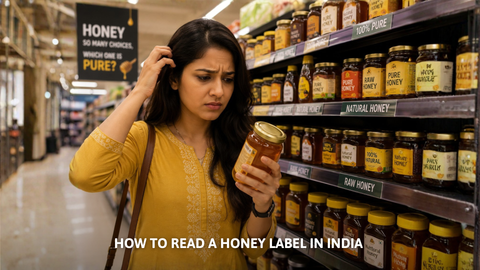
Let’s be honest: walking down the honey aisle in an Indian supermarket can be completely overwhelming. You see dozens of jars, all claiming to be "pure," "natural," or "raw." But how do you actually know what’s inside? With so many brands out there, it’s easy to feel like you need a degree in food science just to buy a simple jar of honey.
If you’ve ever stood in your kitchen, spoon in hand, wondering if your honey is actually honey, you’re not alone. Here is your go-to honey label reading guide to help you cut through the marketing noise and identify pure honey in India.
Step-by-Step: How to Read a Honey Label in India
To ensure you are getting an untampered, high-quality product, follow these steps every time you look at a honey jar:
- Check for a Single-Ingredient List: Flip the jar to the back and verify that the only ingredient listed is 100% honey, with no added syrups or sugars.
- Locate the FSSAI Logo and License Number: Ensure the product carries the mandatory food safety certification for India.
- Look for Government Quality Seals: Spot the Agmark seal, which tells you the official quality grade assigned to the batch.
- Identify the Honey's Origin: Look for specific regional details (like "Sunderbans Mangrove" or "Central Indian Wild Honey") rather than a generic "multi-flora" blend.
- Verify Premium Testing Credentials: Search for "NMR-tested" status to guarantee the honey is completely free from hidden rice or corn syrups.

1. Look for FSSAI Honey Certification
In India, the most basic starting point is the FSSAI (Food Safety and Standards Authority of India) logo. But don’t just stop at seeing the logo on the packaging.
Look for clear labelling that specifies the honey's origin and processing method. Reliable brands are entirely transparent about where their honey comes from, whether it’s harvested from specific wild forests, local ethical apiaries, or distinct geographical regions.
2. Decode the "Pure" Claims
Many commercial brands use flashy buzzwords like "natural" or "pure" right on the front of the bottle. On their own, these terms are mostly marketing fluff.
Instead of trusting the front label, flip the jar over and look at the fine print:
- The Ingredients Rule: True, high-quality honey should list exactly one ingredient: Honey.
- The Red Flags: If you see terms like "added sugar," "syrup," "fructose," or "invert sugar," put the jar right back on the shelf. That is a definitive sign of honey adulteration.
3. Understanding the Indian Agmark Grading System
When buying honey in India, you will often notice an Agmark seal. Agmark is a government-backed certification that assures consumers of an agricultural product's quality and purity. Honey is graded under this system based on rigorous laboratory parameters, including moisture content, sucrose levels, and ash content.
The system breaks down into three main categories:
- Special Grade: The highest tier, indicating exceptionally low moisture content and superior purity.
- Grade A: High-quality honey suitable for premium daily consumption.
- Standard Grade: Meets the basic minimum purity requirements set by the government.
Choosing a brand that carries a clear Agmark certification means the batch has passed official government checks before arriving on your shelf.
4. Single-Origin vs. Commercial Blends
- Most mass-market honey brands sell what are known as Commercial Blends. To maintain a uniform taste, colour, and cheap price point year-round, these companies source cheap honey from various industrial farms, flash-heat it to high temperatures, and ultra-filter it to strip away pollen. This prevents the honey from ever crystallising but leaves it nutritionally dead.
- Single-Origin Honey, on the other hand, is sourced from a specific geographic ecosystem during a particular flowering season.
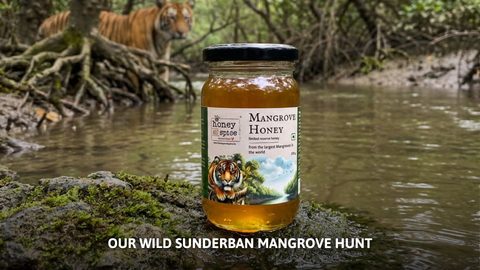
At Honey & Spice, we specialise exclusively in single-origin and wild-harvested honeys. Whether it is our distinct Sunderbans Mangrove Honey or our deep-forest varieties, you taste the exact flowers, climate, and soil of that specific region. It isn't altered in a factory; it is a direct snapshot of nature.
5. The Gold Standard: NMR-Tested Honey
If you really want to know if your honey is untampered with, look for the term NMR (Nuclear Magnetic Resonance).
Honey adulteration is a sophisticated issue in India, where even tests that detect added sugar can sometimes be bypassed by clever food engineering. NMR testing is currently the most advanced method available to detect honey adulteration globally. It acts like a digital "fingerprint" scan, ensuring that the chemical composition is exactly what nature intended and has not been stretched out or altered with cheap rice or corn syrup.
At Honey & Spice, we believe you shouldn't have to guess. That’s why our Central Indian Wild Honey is rigorously NMR tested, giving you total peace of mind that you’re getting exactly what the bees produced, nothing more, nothing less.

6. Understanding the Basics of Purity
Beyond the certifications and seals, keep these natural characteristics in mind:
- Raw vs. Processed: If a label explicitly states "raw," it means it hasn't been pasteurised or heated to high temperatures. This preservation keeps all the delicate, natural enzymes, beneficial pollen, and antioxidants intact.
- Crystallisation: If your honey turns solid, cloudy, or grainy over time, don’t panic! This is actually the ultimate sign of natural, raw honey. Processed, high-heat honey is stripped of pollen and over-filtered so it stays unnaturally liquid on supermarket shelves forever. Real honey crystallises when it gets cold.
Final Thoughts: Choosing with Confidence
Reading honey labels is all about moving away from generic, mass-produced brands and understanding the true craft behind the jar. It’s about knowing that when you pick up a bottle, you’re supporting sustainable harvesting practices and a product that has been handled with absolute respect.
Next time you’re shopping, take a moment to look past the flashy front design. Check for legitimate certifications, scrutinise the ingredient list, and look for that NMR assurance. Your body and your tea will thank you for it!
FAQs
Q1. What is the most basic certification to look for on honey in India?
The most basic starting point is the FSSAI (Food Safety and Standards Authority of India) logo, which ensures the product carries mandatory food safety certification.
Q2. How can I guarantee my honey is free from rice or corn syrups?
Look for "NMR-tested" status. Nuclear Magnetic Resonance testing acts like a digital fingerprint scan to detect advanced adulteration and hidden syrups.
Q3. What does it mean if my honey crystallizes?
Crystallization is actually the ultimate sign of natural, raw honey. Real honey naturally turns solid, cloudy, or grainy when it gets cold, unlike processed honey which is stripped of pollen.
Q4. Are terms like "pure" or "natural" reliable indicators of good honey?
No, these terms are mostly marketing fluff on their own. Instead, flip the jar and ensure the only listed ingredient is 100% honey, with no added sugars or invert syrups.
Q5. What is the difference between commercial blends and single-origin honey?
Commercial blends source cheap honey from various industrial farms, flash-heat it, and ultra-filter it. Single-origin honey is sourced from a specific geographic ecosystem during a particular flowering season, leaving its natural properties intact.