Skip to content

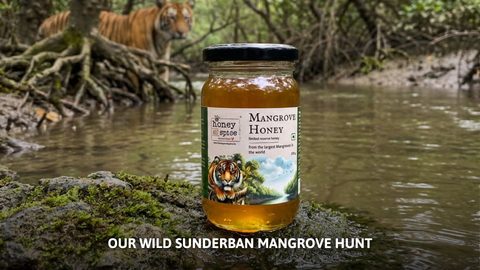
The Sundarbans forest, renowned worldwide for its majestic Royal Bengal Tigers, is also home to something equally remarkable: the extraordinary Sundarbans honey produced by wild bees that forage across the vast, untamed mangrove ecosystems.
Our mission of sourcing mangrove honey felt like travelling to the edge of the world. Or, quite literally, the edge of India.
The Journey to the Edge of India
Getting to the source was an adventure in patience and endurance. It began with a flight to Calcutta, followed by a crowded local train to a small town on the delta's edge. From there, we hopped into a toto (a local auto-rickshaw) to navigate the narrow village roads.

The next leg was a bus ride that came to a sudden halt due to local SIR protests. For a few tense moments, we wondered if we’d have to turn back. But the roads cleared, the journey resumed, and soon, the paved roads disappeared altogether.


Discovering the Raw Mangrove Honey
By the time we arrived, we were running on fumes. Our sanctuary was a humble homestay run by a local villager who catches fish fresh from his backyard and cooks them on the spot for guests. At 4 PM, we had our very first meal of the day. It tasted better than any 7-course fine dining meal we’ve ever had.
But we weren’t there to rest. Backpacks in tow, we rode further into the village. Suddenly, a loud buzzing sound filled the air, resonant, like a distant factory at full production.
Then, we saw them.
Rows of bee hives were nestled neatly under Golpata grass, the same material the villagers use to thatch their homes. It was an incredible sight: thousands of bees were streaming out of the hives, flying directly across the wide river and into the deep forests to collect wild nectar from the untamed mangrove blossoms. Nearby, beekeepers were hard at work, harvesting this precious, raw mangrove honey straight into buckets.

When we tasted it fresh from the comb, we were floored. The mangrove honey was incredibly delicate, light, and literally melted in the mouth, a distinct characteristic of pure mangrove nectar.
Zero Point: The Last Point of Bharat
Just a few meters away from the hives stood a lonely BSF (Border Security Force) outpost known as Zero Point. Beyond that heavily guarded line lies Bangladesh. It is, quite literally, the final checkpoint of Bharat.
Our day ended late after visiting several other apiary sites where the bees were actively working. That night, we sat around a small campfire with the local beekeepers, listening to their jokes, their daily worries, and their aspirations for the future. It was a grounding moment that reminded us of a simple truth:
"Life is the same everywhere. Some of us are just more privileged."
Secrets of the Mangrove Flora
The following day, we travelled even deeper into the river channels by boat to learn about the unique vegetation of the delta. The exceptional flavour and medicinal profile of authentic Sunderbans mangrove honey rely entirely on the rich biodiversity of the region's mangrove flora. As we drifted through the narrow channels, we learned how each tree lends its own magic to the final blend. The Khalisa flowers give the honey its signature light, sweet, and premium floral notes, while Keora blossoms add a subtle, complex depth to the aroma. Finally, trees like Gewa and Goran contribute to the high nutrient density and powerful health properties that make this Sundarbans forest honey so legendary.

As we continued down the waterways, the locals shared harrowing stories of tiger attacks, real accounts from those who survived, and their deep-rooted faith in Bonbibi, the guardian goddess who protects the villagers from the dangers of the forest.
The Journey Continues
When we finally turned back toward Bangalore, we carried much more than just premium mangrove honey from Sundarbans. We carried vibrant stories, newly forged relationships, and a renewed sense of purpose.
There are still so many hidden corners of the country to visit. Many more unique honeys, rare spices, and traditional delicacies are waiting to be discovered, and we can't wait to bring them directly to your table.
FAQs
Q1. What makes Sunderbans mangrove honey different?
It is produced by wild bees foraging on unique mangrove flora like Khalisa and Keora, giving it a delicate, melting texture and rich nutrient profile.
Q2. Is Sunderbans honey safe to consume?
Yes, authentic Sunderbans honey is completely natural and raw. It is carefully harvested by local beekeepers and packed with natural health benefits.
Q3. How do beekeepers collect honey in the Sunderbans?
Beekeepers set up apiaries near the forest edge, allowing bees to forage in the wild mangroves. The honey is sustainably harvested directly from the comb.
Q4. What flowers do bees collect nectar from in the Sunderbans?
Bees collect nectar from a variety of native mangrove trees, including Khalisa, Keora, Gewa, and Goran, which contribute to the honey's complex flavor.
Q5. Why is mangrove honey considered rare?
It is rare because it can only be sourced during specific blooming seasons in the dangerous, remote marshlands of the Sunderbans delta.