Skip to content

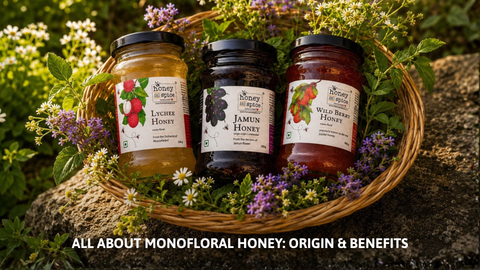
When you think of honey, you might picture a standard golden liquid with a simple, sugary taste. But in the world of raw, natural honey, every jar tells a completely different story depending on where the bees forage. Just like fine wine or single-origin coffee, honey carries the distinct flavour, colour, and therapeutic properties of the specific flowers from which it was crafted.
What is Monofloral Honey?
Monofloral honey (also called unifloral or single-origin honey) is honey produced predominantly from the nectar of one single species of flower.
While multi-floral or wild forest honeys come from bees foraging across dozens of different plants simultaneously, monofloral honey occurs when bees collect nectar almost exclusively (>45–50% pollen count) from a specific blossom such as Jamun, Acacia, or Lychee. Because nectar chemistry varies from plant to plant, monofloral honeys boast unique, unblended flavours, distinct aromas, and targeted health benefits tied directly to that botanical source.

How Organic Monofloral Honey is Procured?
Extracting pure monofloral honey requires deep seasonal knowledge, sustainable beekeeping, and precise timing:
- Migratory & Seasonal Beekeeping: Beekeepers place hives directly near specific crops or forests right as they enter peak bloom. Once the flowering period ends (which usually lasts only a few weeks), the honey is harvested before the bees begin foraging on other plant species.
- Chemical-Free Ecosystems: Our organically procured honey comes from hives situated far from synthetic pesticides, chemical fertilisers, and polluted urban areas. Beekeepers maintain natural hive management without antibiotics.
- Cold Extraction & Raw Processing: To qualify as true raw honey, it is extracted gently without high heat or ultra-filtration. Keeping the temperature below hive level (~35°C–40°C) preserves live enzymes, natural antioxidants, micro-nutrients, and native pollen grains intact.
Benefits of Monofloral Honey
Choosing raw monofloral honey isn't just an upgrade for your pantry; it offers a wide spectrum of benefits for your body, skincare, hair care, and daily lifestyle:
- Targeted Botanical & Therapeutic Benefits: Unlike generic blended honey, monofloral varieties carry the concentrated medicinal properties of a single dominant flower source, such as low-GI support from Jamun or sinus and respiratory relief from Eucalyptus.
- Rich in Active Live Enzymes & Bioactive Antioxidants: Unheated single floral honey preserves temperature-sensitive live enzymes (like diastase and invertase) alongside flavonoids and phenolic acids that aid digestion, strengthen immunity, and fight oxidative stress.
- Potent Natural Antimicrobial & Antibacterial Action: High concentrations of natural hydrogen peroxide compounds make it a powerful natural remedy for soothing sore throats, clearing coughs, and neutralising acne-causing bacteria on the skin.
- Deep, Weightless Hydration for Glowing Skin: As a natural humectant, it draws moisture directly into skin tissues, providing gentle enzymatic exfoliation to clear dead skin cells, soothe eczema, and restore a clear, radiant complexion.
- Nourishes Hair & Restores Scalp Health: Its natural antifungal and soothing properties help balance the scalp microbiome to combat dandruff-causing yeast, while locking moisture into dry hair strands to reduce breakage and add shine.
- Unmatched Culinary Flavour & Terroir: Free from factory mixing, every jar delivers an authentic taste of a specific ecosystem, ranging from the rich cocoa notes of Coorg Coffee honey to the delicate fruitiness of Lychee honey, making it a delicious, unrefined sugar alternative.
- Pure, Unadulterated & Naturally Long-Lasting: With naturally low moisture content and balanced acidity, raw monofloral honey offers exceptional shelf life without needing synthetic preservatives, fillers, or high-heat processing.
Single Floral Honey vs. Blended Supermarket Honey: Enzymes & Glycemic Index (GI)
Not all honey sitting on grocery shelves offers the same nutritional value. The difference between single floral honey and mass-market blended honey comes down to processing, enzyme integrity, and metabolic impact:
1. Live Enzyme Preservation
- Single Floral Honey: Raw, single floral honey is harvested using cold-extraction methods. This leaves vital, temperature-sensitive enzymes such as diastase (which breaks down starches), invertase (which converts complex sugars into simple, digestible sugars), and glucose oxidase (which creates natural antimicrobial properties) fully active.
- Blended Supermarket Honey: Mass-market honey blends are frequently heated to high temperatures (pasteurised) to prevent crystallisation and ultra-filtered to strip away pollen. This flash-heating destroys sensitive enzymes and antioxidants, leaving behind a heat-processed sugar syrup.
2. Glycemic Index (GI) & Fructose-to-Glucose Ratios
- Single Floral Honey: The Glycemic Index (GI) of honey depends heavily on its natural fructose-to-glucose ratio, which varies depending on the flower source. Monofloral honeys like Sulai (Wild Acacia) or Jamun naturally contain higher fructose levels relative to glucose. This results in a lower GI score, leading to a slower, more gradual release of energy without causing sharp blood sugar spikes.
- Blended Supermarket Honey: Blended commercial honeys combine various cheap honey sources (and sometimes hidden glucose syrups) to achieve a uniform, ultra-sweet taste. This yields a higher overall GI, causing rapid blood glucose spikes and energy crashes similar to refined sugar.
 Monofloral Honey vs. Infused Honey: What’s the Difference?
It’s easy to confuse monofloral honeys with infused honeys, but their creation processes are fundamentally different:
- Monofloral Honey is created entirely by the bees. The flavour, colour, and medicinal qualities come straight from the nectar of the specific flower species the bees visited.
- Infused Honey is created after harvesting. A base honey (usually multi-floral) is mixed or steeped with external ingredients, such as whole spices, ginger root, tulsi leaves, or essential oils.
| Feature | Monofloral Honey | Infused Honey |
|---|---|---|
| Source of Flavour | Natural nectar collected by bees | External additives added post-harvest |
| Ingredients | 100% Pure Raw Honey | Raw Honey + Added Herbs/Spices/Oils |
| Pollen Profile | Predominantly single-flower pollen | Mixed pollen profile |
| Creation Process | Natural foraging during bloom season | Culinary steeping/mixing process |
Why Should We Consume Monofloral Honey?
With so many sweeteners available, why should single-origin monofloral honey be your top choice?
- Intentional & Functional Wellness: Instead of using honey blindly, monofloral honey allows you to select a variety tailored to your exact wellness goals, whether you need soothing throat relief, digestive support, a low-GI sweetener, or a natural face mask base.
- Total Traceability & Authenticity: Single-origin honeys can be traced directly to a specific region, flower blossom, and harvest season, ensuring you receive genuine, unadulterated honey.
- Supports Sustainable Beekeeping: Producing monofloral honey requires beekeepers to follow seasonal blossom cycles and protect local flora, encouraging sustainable biodiversity and ethical hive management.
- Unmatched Culinary Experience: From the malty depth of Coorg Coffee honey to the delicate fruitiness of Lychee honey, monofloral varieties offer complex flavour profiles that elevate teas, breakfasts, and recipes.
Types of Monofloral Honey:
Here is a quick look at the popular single-origin monofloral honey varieties harvested across diverse Indian ecosystems:
- Jamun Honey
- Moringa Honey
- Lychee Honey
- Coorg Coffee Honey
- Sulai Honey
- Wild Acacia Honey
- Kashmiri Apple Honey
- Sunflower Honey
- Vana Tulsi Honey
- Desert Honey (Khejri Flora)
- Wild Berry (Sidr) Honey
- Rosewood (Sheesham) Honey
- Mustard Honey
- Eucalyptus Honey
Honey & Spice’s 13 Monofloral Honey Varieties: Origins & Benefits
Honey & Spice sources its single-origin honeys sustainably across diverse Indian ecosystems. Here is a guide to 13 of their monofloral varieties, detailing where they come from and what makes them special:
 1. Jamun Honey
- Origin: Sourced from the lush Jamun orchards along the borders of Uttar Pradesh and Uttarakhand during early summer.
- Benefits: Features a deep amber hue with a subtle, pleasant bitterness. Renowned for its low glycemic index, making it a popular natural choice for managing blood sugar levels and delivering rich antioxidant protection.
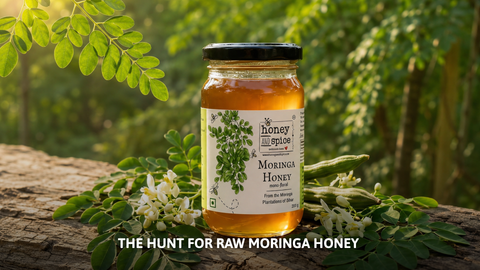
 2. Moringa Honey
- Origin: Sourced from blooming drumstick (Moringa) plantations across Jharkhand and parts of South India.
- Benefits: Earthy and herbal in profile, this honey packs the nutritional punch of the superfood Moringa. It serves as an exceptional immune booster rich in natural anti-inflammatory compounds and essential vitamins.
 3. Lychee Honey
- Origin: Harvested from the vast lychee orchards of Muzaffarpur, Bihar, during the brief spring flowering season.
- Benefits: Light, golden, and delicate with a delightfully fruity floral taste. It is packed with active natural enzymes that aid digestion, soothe acid reflux, and nourish skin health.
 4. Coorg Coffee Honey
- Origin: Harvested from the shade-grown coffee plantations of Coorg, Karnataka, right when the white coffee blossoms bloom.
- Benefits: Deep and aromatic with distinct undertones of cocoa and warm spices. High in natural polyphenol antioxidants, it offers a clean, jitter-free energy boost.
 5. Sulai Honey
- Origin: Sourced from the high-altitude Ramban valley in Jammu & Kashmir.
- Benefits: Exceptionally clear and mild with a soft floral aroma. Due to its high natural fructose content, it resists crystallisation, making it a soothing remedy for sore throats and ideal for daily sweetening.
 6. Kashmiri Apple Honey
- Origin: Collected from blooming apple orchards across the Kashmir Valley during spring.
- Benefits: Light amber with a smooth, fruity sweet fragrance. It is known to calm sensitive digestive systems, support gut flora, and deliver key trace minerals.
 7. Sunflower Honey
- Origin: Sourced from bright sunflower fields across rural Karnataka and Maharashtra.
- Benefits: Vibrant yellow and quick to naturally crystallise into a rich, creamy butter texture. High in essential fatty acids and antioxidants, it supports heart health and joint wellness.
 8. Vana Tulsi Honey
- Origin: Harvested from wild forest basil blossoms in the Himalayan foothills and Central Indian sanctuaries.
- Benefits: Highly aromatic and herbaceous. Rooted in Ayurvedic traditions, it helps clear upper respiratory congestion, calms coughs, and balances daily stress levels.
 9. Desert Honey (Khejri Flora)
- Origin: Sourced from the arid Thar Desert region of Rajasthan, collected from resilient Khejri tree blossoms.
- Benefits: Mineral-dense with a unique earthy sweetness. It provides robust antimicrobial protection and helps soothe stomach ailments in harsh conditions.
 10. Wild Berry (Sidr) Honey
- Origin: Harvested from wild Sidr (Jujube/Ber) trees growing in dry pockets of Rajasthan and Haryana.
- Benefits: A thick, golden-amber honey with a caramel-like richness. Globally acclaimed for its potent antibacterial, liver-protective, and wound-healing properties.
 11. Rosewood (Sheesham) Honey
- Origin: Sourced from Indian Rosewood (Sheesham) groves situated across the northern plains of India.
- Benefits: A warm amber honey with subtle woody floral notes. Traditionally used to improve blood circulation, relieve stomach cramps, and ease digestive discomfort.
 12. Mustard Honey
- Origin: Harvested from vibrant yellow mustard fields across Punjab and Rajasthan during peak winter.
- Benefits: Naturally crystallises into a smooth, white spreadable consistency with a warm, mild flavour. It promotes circulation, supports heart wellness, and offers natural cold relief in the winter months.
 13. Wild Acacia Honey
- Origin: Harvested from high-altitude Acacia blooms in Jammu & Kashmir's Ramban Valley.
- Benefits: Mild, clear, and naturally low-GI. Its high fructose content keeps it liquid longer, making it a soothing, easy-to-digest sweetener for sore throats and sensitive stomachs.
Final Thoughts: Finding Your Perfect Single-Origin Honey
Honey is so much more than just a sweet substitute for sugar. When you opt for pure, raw monofloral honey, you aren't just buying a jar of sweetener; you're tasting a direct snapshot of a specific flowering season, ecosystem, and botanical blossom, completely untouched by factory processing.
Whether you're looking for the respiratory comfort of Eucalyptus or Vana Tulsi, the low-glycemic perks of Jamun, or the rich caramel decadence of Wild Berry (Sidr), there’s a single-origin honey crafted by nature for every taste bud and wellness routine.
Next time you reach for honey, skip the heavily filtered, mass-market blends sitting on supermarket shelves. Give your body and your palate the raw, unadulterated goodness it deserves. Explore Honey & Spice’s collection of 13 raw monofloral honeys and discover the true, unblended flavours of nature!
Disclaimer
The health and nutritional information provided in this article is for educational purposes only and should not be used as a substitute for professional medical advice, diagnosis, or treatment. Always consult with a qualified healthcare provider before using raw honey for therapeutic purposes, especially if you are managing underlying medical conditions like diabetes or severe seasonal allergies.
FAQs
Q1. What is the difference between monofloral and multifloral honey?
Monofloral honey is produced primarily from the nectar of a single plant species, giving it a distinct flavor and specific health benefits. Multifloral honey is made from the nectar of many different flowers, resulting in a more generalized taste and nutritional profile.
Q2. Is monofloral honey better than regular supermarket honey?
Yes, raw monofloral honey retains live enzymes, unique antioxidants, and natural pollen that are often destroyed in heated, heavily filtered regular supermarket honey blends.
Q3. Does monofloral honey naturally crystallize?
Yes, pure monofloral honey can naturally crystallize over time. The rate of crystallization depends on the flower source, with high-fructose honeys like Wild Acacia staying liquid longer and high-glucose varieties like Mustard honey crystallizing faster.
Q4. How do beekeepers harvest monofloral honey?
Beekeepers carefully place their hives near a specific blooming crop, like a lychee orchard or sunflower field, and harvest the honey right after the short blooming season ends before the bees begin to forage on other flora.
Q5. Which monofloral honey has a lower glycemic index?
Jamun honey and Wild Acacia honey are popular choices because they naturally contain a higher fructose-to-glucose ratio, resulting in a lower glycemic index and a slower, more gradual release of energy.
Q6. Can I use single-origin monofloral honey on my skin?
Absolutely. Raw monofloral honeys have potent natural antibacterial properties and act as gentle humectants, making them excellent for soothing acne, providing enzymatic exfoliation, and offering deep skin hydration.
Q7. Does raw monofloral honey expire?
Pure, raw monofloral honey has an incredibly long shelf life and technically does not expire due to its low moisture content and natural acidity, provided it is stored properly in a sealed glass jar away from direct moisture and extreme heat.