Skip to content

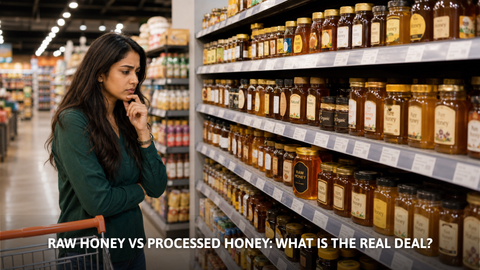
We’ve all stood in the supermarket aisle, staring at rows of honey, wondering which one is actually the "better" choice. Between labels screaming "natural," "pure," and "organic," it’s easy to feel overwhelmed. But here is the truth: not all honey is created equal, and understanding the difference could change the way you nourish your body.
What is Raw Honey?
Think of raw honey as honey exactly as the bees intended it to be. It is extracted directly from the honeycomb and lightly strained to remove wax particles, but crucially, it is not heated to high temperatures. By skipping the heavy processing, raw honey keeps its natural enzymes, antioxidants, trace pollen, and complex aroma compounds intact. When you choose raw and pure honey, you’re getting a living superfood, not just a sweetener
The Molecular Breakdown: Chemical Properties of Raw vs. Processed Honey
To truly understand the difference, we have to look at the chemical composition of honey.
- Raw Honey: In its natural state, raw honey is a complex, supersaturated sugar solution containing roughly 80% carbohydrates (predominantly natural fructose and glucose) and 17% water. The remaining 3% is a powerful matrix of bioactive compounds, including vitamins (B-complex and Vitamin C), minerals (calcium, iron, potassium), amino acids, and over 30 types of polyphenols and flavonoids (antioxidants).
- Processed Honey: When honey undergoes commercial processing, intense heat structurally alters its chemistry. High temperatures break down the volatile organic compounds responsible for honey's unique floral aroma. Furthermore, thermal processing rapidly increases levels of Hydroxymethylfurfural (HMF), a chemical compound that serves as a global marker for heat damage and ageing in honey, while stripping away the essential trace minerals and antioxidants.

The Difference Between Raw and Pure Honey
It is easy to confuse these terms, but they have distinct meanings. "Pure" often just means that no other ingredients (like sugar syrup) have been added. However, "pure" honey can still be heavily processed or pasteurised. "Raw," on the other hand, guarantees that the honey hasn't been subjected to heat that destroys its medicinal properties.
Pasteurised vs. Unpasteurized Honey
-
Pasteurised Honey: This honey is heated to high temperatures and then cooled. This process kills off beneficial enzymes, delays crystallised honey formation, and keeps the product looking unnaturally clear and runny on the shelf
- Unpasteurized (Raw) Honey: This is the "alive" version. It may look cloudy or hazy, and that is a good thing! That haze is often due to the presence of pollen and natural nutrients
If you notice your jar of honey turning solid or grainy over time, a process known as naturally crystallised honey, don’t panic! This is not a sign of spoilage; it’s actually the best indicator that you have purchased raw, high-quality honey.

The Science of Living Food: Live Enzymes vs. Thermal Denaturation
The defining health benefit of raw honey lies in its live enzymes. Raw, unheated honey contains active enzymes like diastase (amylase), invertase, and glucose oxidase, which are introduced by the bees during honey production.
- The Power of Glucose Oxidase: This specific live enzyme breaks down glucose to produce low levels of hydrogen peroxide. This is the exact chemical reaction responsible for honey’s legendary antibacterial, antimicrobial, and wound-healing properties
- The Denaturing Effect of Pasteurisation: Commercial pasteurisation typically heats honey to temperatures between 60°C to 70°C (140°F to 158°F). This extreme heat triggers thermal denaturation, a process where the delicate, three-dimensional protein structures of these live enzymes are permanently warped and broken down. Once denatured, the enzymes become completely inactive. Pasteurisation effectively turns a biologically active, therapeutic superfood into a dead, empty liquid sugar
Why Quality Matters: Organic and Pure Benefits
When you look for organic honey benefits, you are looking for products certified to be free from synthetic pesticides and herbicides in the areas where the bees forage. Pure organic honey benefits go beyond just taste; they offer the assurance that you are consuming a product handled with respect, free from adulteration like rice or corn syrup.
How to Shop Like a Pro
- Flip the jar: If the ingredient list contains anything other than "Honey," put it back.
- Look for NMR testing: In India, honey adulteration can be clever. NMR (Nuclear Magnetic Resonance) testing acts like a "fingerprint" scan, ensuring the honey’s chemical composition is exactly what nature intended.
- Embrace the texture: If your honey crystallises, it’s a sign of its raw, authentic nature.

Unmasking Adulteration: How NMR Testing Safeguards the Indian Honey Market
In the Indian market, checking for purity has become more critical than ever. Traditional laboratory tests, such as C3 and C4 sugar testing, are often bypassed by sophisticated adulterators who mix honey with specialised C3 plant syrups like rice syrup, inverted sugar syrup, and high-fructose corn syrup (HFCS). Because rice syrup shares a similar isotopic profile to honey, older testing methods fail to flag it.
This is where Nuclear Magnetic Resonance (NMR) testing changes the game.
NMR spectroscopy works by exposing a sample of honey to a powerful magnetic field and radio waves. This causes the nuclei of the molecules to resonate, generating a highly specific, digital molecular "fingerprint." This profile is then cross-referenced against a global database of thousands of authentic, pure honey samples.
NMR testing can detect trace foreign sugar syrups down to an incredibly precise 1% detection limit. It also accurately verifies the botanical source and geographical origin of the honey. When you choose an NMR-tested honey brand in India, you are relying on rigorous, raw laboratory data to ensure your jar is free from hidden rice syrup and 100% bee-made.

Conclusion
Ultimately, the choice between raw and processed honey comes down to whether you want a simple sweetener or a potent, natural superfood. While standard honey might look prettier on a shelf, the real nutritional magic lies in the raw, unfiltered, and honest jars. By choosing raw, you’re investing in your long-term health and supporting more sustainable, traditional beekeeping practices. So, the next time you shop, look past the clear, uniform glow of commercial bottles and embrace the cloudy, golden, and authentically crystallised goodness of raw honey. It’s a small, sweet swap that truly nourishes you from the inside out.
FAQs
Q1. Is raw honey better than processed honey?
Yes, raw honey retains its natural enzymes, antioxidants, and trace minerals because it hasn't been heated. Processed honey loses many of these health benefits during extreme heating.
Q2. How can you tell if honey is raw or processed?
Raw honey often has a cloudy or hazy appearance and will crystallize over time. Processed honey typically looks unnaturally clear, very runny, and rarely turns solid.
Q3. Is pure honey the same as raw honey?
No, they are different. "Pure" means no other ingredients were added, but it can still be pasteurized and heated. "Raw" means it has never been subjected to high heat, preserving its medicinal properties.
Q4. Why does raw honey crystallize?
Crystallization is a natural process indicating high-quality, raw honey. It happens because raw honey is a supersaturated sugar solution containing natural pollen and enzymes that encourage the honey to solidify.
Q5. What is NMR tested honey?
NMR testing creates a molecular fingerprint of the honey to verify its purity. It guarantees the honey is 100% bee-made and free from hidden adulterants like rice or corn syrup.