Skip to content

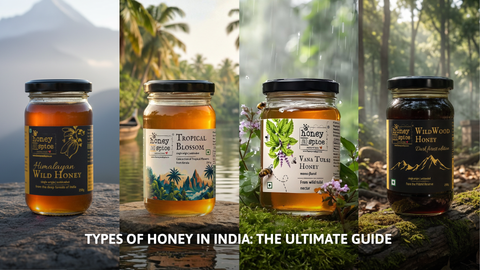
If you think all honey is the same, you are not alone. Honey is not a single, uniform product. Its taste, colour, thickness, aroma, and health benefits depend on where it comes from, which flowers the bees visit, and how it is processed.
There are over 300 types of honey in the world. We can mainly classify honey based on its floral source (monofloral and multifloral), processing method (raw honey, pasteurised honey, and infused honey), source of origin (wild, farm, and cliff), and production practices (organic and conventional).
Understanding these variations is crucial, especially when exploring types of honey in India. Whether you are searching for pure unpasteurised honey or exploring single-origin floral varieties, this comprehensive guide breaks down everything you need to know about purchasing unpasteurised honey and making informed choices.
Types of Honey: Based on Floral Source
The floral source is the primary way to classify raw honey types.
Monofloral vs. Multifloral Honey
Monofloral Honey
Monofloral honey comes mainly from the nectar of a single floral species, giving it a distinct flavour, aroma, and colour. Below are prominent raw honey types available globally and across India:
- Manuka Honey: Dense, slightly bitter, and deeply earthy with a medicinal aroma. Sourced from the Manuka tree native to New Zealand and Australia, it is world-renowned for non-peroxide antibacterial properties (graded via UMF and MGO).
- Acacia Honey: Almost weightless, pale gold, and slow to crystallise due to high fructose levels. Harvested from Black Locust trees in the Kashmir Valley, it sweetens without overpowering original food flavours.
- Buckwheat Honey: Dark brown, viscous, and malty, packed with high antioxidant concentrations. Sourced from buckwheat blossoms (Kuttu ke phool) in cold, mountainous Himalayan belts.
- Sulai Honey (GI-Tagged): Soft, smooth, and amber-toned with gentle sweetness. Harvested from the Sulai flower (Vana Tulsi family) in Jammu & Kashmir’s Ramban region, it holds India's prestigious Geographical Indication (GI) tag.
- Jamun Honey: Dark, thick, and rich with woody undertones and a tangy edge. Sourced from short-lived Jamun blossoms in Northern and Central India, widely valued for traditional health routines.
- Moringa Honey: Warm, herbal, and slightly nutty, harvested from delicate drumstick tree orchards in Jharkhand and Bihar.
- Lychee Honey: Light amber, smooth, and fruity-sweet with a dessert-like aroma. Sourced from lychee orchards in Muzaffarpur, Bihar.
- Wild Berry Honey (Sidr): Complex, layered sweetness harvested from Ber blossoms (Ziziphus / Sidr) in dry regions of Rajasthan and the Deccan Plateau.
- Eucalyptus Honey: Bold, sharp, and cooling at the back of the throat. Collected from eucalyptus groves across Southern and Northern India.
- Rosewood Honey (Sheesham): Medium amber with forest-like woody notes, harvested from rare rosewood tree blooms in Himalayan foothills.
- Mustard Honey: Mild and sweet with a subtle tang. Naturally low in moisture, this unpasteurised honey crystallises rapidly into a smooth, creamy spread. Sourced along the Brahmaputra River banks.
- Vana Tulsi Honey: Deep amber, aromatic, and warm with spicy herbal notes. Sourced from wild holy basil fields in Bihar.
- Kashmiri Apple Honey: Light, golden, and fresh, with orchard notes, harvested during the brief spring apple-blossom season in Kashmir.
- Sunflower Honey: Bright golden yellow, warm, and balanced. Sourced from sunflower fields in Ambala and Kurukshetra.
- Orange Blossom Honey: Light amber, fragrant, and citrus-zesty. Harvested from blooming orange orchards in Punjab.

Multifloral Honey
Multifloral honey is honey made when bees collect nectar from many different types of flowers growing in the same region, instead of relying on a single flower source.
Because the nectar comes from multiple flowers, the taste, colour, and aroma of multifloral honey vary naturally depending on the season and location.
What defines multifloral honey:
- Sourced from multiple flower varieties
- Flavour changes with each harvest
- Usually balanced and not overpowering
-
Suitable for everyday use
Unlike monofloral honey, multifloral honey is not tied to one specific bloom. It reflects the overall floral diversity of the area where bees forage.
This natural mix makes multifloral honey more consistent in availability and a good choice for people looking for a versatile, daily honey with natural variation rather than a fixed taste profile.
Common types of monofloral honey are:
- Wild/Forest honey
- Cliff honey
- Mangrove honey
- Desert honey

Types of Honey: Based on Processing Method
The way honey is handled after harvesting dictates its nutritional integrity, enzymes, texture, and shelf life.
1. Raw Honey (Unpasteurised Honey)
Raw honey is unpasteurised honey in its purest, most authentic state. It is extracted directly from the comb, gently strained to remove honeycomb bits, and never subjected to high-temperature heating or ultra-filtration.
- Enzyme Retention: Pure unpasteurised honey retains naturally occurring enzymes (like diastase and invertase), trace pollen, and propolis.
- Crystallisation: Real unpasteurised honey will naturally granulate or crystallise over time. This is not a sign of spoilage or added sugar; rather, it guarantees that the honey is unpasteurised honey preserved in its raw state.
- Appearance: Often appears cloudy or hazy due to micro-particles of beneficial bee pollen.
Some examples of Raw honey are acacia, manuka, buckwheat and multifloral honey.
Major health benefits of choosing raw honey are:
- Fights cell harm: High levels of plant antioxidants (polyphenols) lower cell stress.
- Calms coughs: Acts as a natural throat and cough soother for children over age one.
- Aids wound healing: Its antibacterial traits can help heal minor burns and skin sores.
- Supports gut health: Contains prebiotics that feed good bacteria in your stomach

2. Pasteurised Honey
Pasteurised honey undergoes high-heat processing followed by rapid cooling.
- Purpose: Delays crystallisation, increases liquid clarity, and facilitates mass-market bottling.
- Trade-off: High thermal exposure degrades delicate heat-sensitive enzymes, neutralises subtle volatile aromas, and strips away trace nutrients.
Some examples of pasteurised honey include Dabur, Zandu, Patanjali, and Apis Himalaya.
Major health benefits of choosing pasteurised honey are:
- Longer shelf life: High heat destroys active yeast cells, preventing fermentation.
- Stays liquid longer: Fine filtering and heating remove particles and dissolve sugar crystals, slowing down crystallisation.
- Smooth texture: Provides a clear, uniform appearance and a consistent, mild flavour that blends easily into foods and drinks.
- Safe basic sweetener: Serves as a shelf-stable carbohydrate source and quick energy booster.

3. Infused Honey
Infused honey combines a pure honey base with natural herbs, roots, or spices like ginger, cinnamon, or turmeric. It acts as a functional variation for daily wellness routines while maintaining the base honey's natural characteristics.
Some examples of infused honey include turmeric-infused, cinnamon-infused, ginger-infused, and ajwain-infused honey.
Major health benefits of choosing pasteurised honey are:
- Immune Support: Garlic or elderberry-infused honey adds potent antimicrobial and immune-stimulating plant compounds to raw honey's baseline defences.
- Soothes Digestion: Ginger-infused honey helps calm an upset stomach, ease nausea, and support overall gut comfort.
- Calms the Nervous System: Chamomile or lavender-infused honey provides relaxing properties that help reduce stress and promote restful sleep.
- Relieves Coughs: Eucalyptus or mint-infused varieties help coat a scratchy throat and ease respiratory congestion.

Pure & Raw Honey Brands in India
If you are looking to purchase authentic unpasteurised honey in India, choosing a transparent brand that focuses on raw, single-origin sourcing is essential.
- Honey and Spice: Leading the movement for authentic unpasteurised honey, Honey and Spice offers raw, wild, single-origin varieties harvested directly from the Himalayas, Western Ghats, and untouched forest belts without high-heat processing or artificial blending.
- Two Brothers Organic Farms: Known for sustainable agricultural practices, offering raw forest and single-origin farm honeys.
- Indigenous Honey: Focuses on raw, cold-extracted honey packaged directly in glass jars to preserve natural enzymes.
- Pahadi Source: Specialises in single-origin, raw Himalayan honeys sourced directly from local mountain beekeepers.
- Ritvaam: Offers raw, unheated wild honeys including rare, GI-region Sundarban mangrove varieties.
By understanding how floral sources, regional habitats, and processing methods shape every jar, you can steer clear of overly processed syrups and select pure, unpasteurised honey tailored to your taste and wellness preferences.
FAQs
Q1. What are the main types of honey available in India?
In India, honey is primarily categorized by its floral source. Popular varieties include acacia, jamun, mustard, eucalyptus, and multifloral honey. Each type has a unique colour, taste, and consistency based on the flowers the bees pollinate.
Q2. What is the difference between raw honey and regular pasteurised honey?
Raw honey is minimally processed, unheated, and retains its natural enzymes, pollen, and antioxidants. Regular pasteurised honey is heated to high temperatures to prevent crystallisation and improve clarity, which can destroy some beneficial nutrients.
Q3. What is the difference between monofloral and multifloral honey?
Monofloral honey is made by bees that collect nectar predominantly from one specific type of flower, giving it a distinct flavour. Multifloral honey is produced from the nectar of various blooming flowers in a specific region, resulting in a balanced, versatile taste.
Q4. Why does some honey crystallise faster than others?
Crystallisation is a natural process, and its speed depends on the floral source and the ratio of natural sugars like glucose and fructose. Raw honey crystallises naturally, which is a sign of its purity, whereas heating slows this process down.
Q5. Is crystallised honey safe to eat?
Yes, crystallised honey is completely safe to eat. It is not a sign that the honey has gone bad; you can simply place the jar in warm water to return it to a liquid state if you prefer.
Q6. Which type of honey is best for daily use?
Multifloral honey is widely considered the best choice for everyday use because it has a balanced, mild flavor that works well in tea, cooking, and daily consumption.
Q7. What are the benefits of organic honey?
Organic honey is produced following certified farming practices that avoid harmful chemicals and pesticides. It offers the same natural flavours and nutrients as raw honey while ensuring environmentally friendly beekeeping methods.