सामग्री पर जाएं

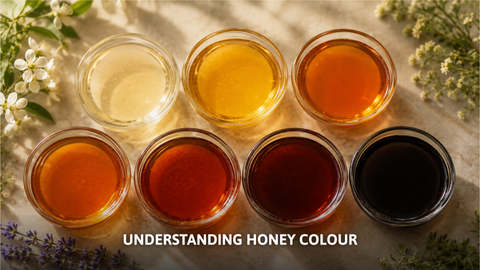
Lined up along a local beekeeper’s shelf, jars of unpasteurized honey display an incredible visual spectrum. One bottle might shimmer like liquid diamonds, virtually clear and pale gold, while the jar right next to it gleams with the deep, opaque hue of dark molasses or burnt caramel.
For many shoppers, this striking variation raises immediate questions. Is pale honey diluted? Is dark honey burnt or old? And how does raw honey colour correlate with flavour, nutrient density, and culinary usefulness?
Understanding the colour of honey opens up a whole new world of natural flavour profiles and nutritional benefits. Whether you are searching for the ideal natural sweetener for your morning tea or evaluating light vs dark honey, which is better for your health, this guide covers everything you need to know about nature's liquid gold.
Why Does Honey Have Different Colours? The Science Behind Your Jar
When people ask why does honey has different colours, the answer lies in the extraordinary relationship between honeybees and floral ecology. Honey is not a single, standardised product manufactured in a factory; it is a snapshot of a specific landscape at a specific point in time.

What Determines the Colour of Honey?
If you have ever wondered what determines the colour of honey, several natural and environmental variables come into play:
- Floral Nectar Origin: The primary driver of honey colour is the species of flower visited by foraging bees. For instance, bees gathering nectar from acacia or clover produce nearly translucent, white honey, whereas bees visiting jamun blossoms, coffee plantations, or dense jungle flora yield deep amber or dark honey.
- Soil Mineral Composition: Plants growing in soil rich in minerals, particularly iron, copper, and manganese, pass those minerals into their nectar, resulting in a noticeably darker raw honey colour.
- Seasonal Timing: Spring blooms generally yield lighter nectar with delicate floral aromatics, whereas late summer and fall blossoms produce darker nectar loaded with dense plant compounds.
 Does Honey Change Colour Over Time?
A common concern among kitchen pantries is: Does honey change colour over time?
Yes, pure honey undergoes natural transformation:
- The Maillard Reaction & Oxidation: As honey ages, natural amino acids and sugars slowly interact in a mild Maillard reaction. Oxygen exposure and warm ambient storage temperatures cause liquid honey to gradually darken over months and years.
- The Crystallisation Process: When glucose molecules separate from water and form solid crystals, the light refracts differently through the jar. During the natural crystallisation process, honey turns paler, creamier, and opaque. Once gently warmed in a warm water bath, the crystals melt back into liquid, restoring their original dark or amber shade.

A widespread misconception leads consumers to ask which colour honey is pure.
According to guidelines established by the Food Safety and Standards Authority of India (FSSAI), authentic raw honey naturally ranges in colour from nearly colourless to dark brown. The FSSAI strictly prohibits added food colours, dyes, or artificial sugar syrups in pure honey.
The reality is that honey colour has zero bearing on adulteration or authenticity. A crystal-clear Acacia honey and an ink-dark wild forest dark honey can both be 100% pure, raw, and unheated. Purity is defined by compliance with FSSAI quality parameters (such as zero-added sugar syrup, low HMF, and natural NMR testing), not by shade.
FSSAI Standards & Honey Colour Chart: Mapping the Honey & Spice Collection
Under FSSAI regulations and Indian Agmark classification standards, pure honey is tested for sensory parameters, optical density, and chemical integrity to ensure zero adulteration. To evaluate honey colour grading, laboratories measure light transmittance using the standard Pfund Scale (expressed in millimetres, from 0 mm for water-clear to over 114 mm for dark amber).
Here is how the honey colour chart maps onto the authentic, raw honey collection from Honey & Spice:
Beyond the Colour Chart: Rare & Exotic Honeys with Unique Hues
While the standard Pfund scale covers shades from clear to dark brown, nature occasionally produces extraordinary honeys that defy standard colour categories. These rare, exotic varieties get their unique pigments from specialised flora, unusual foraging conditions, or unique bee species.

1. Himalayan Red Honey (Deep Reddish-Ruby Hue)
- The Look: A breathtaking, deep ruby-red hue that glows warm and crimson when held to natural light.
- The Sourcing: Harvested from high-altitude Himalayan cliffs where giant wild bees (Apis laboriosa) feed on wild Himalayan Borage blossoms.
- Flavour Profile: Warm, complex, and mildly bitter with a unique spicy floral undertone. Known in mountain tradition for natural winter warming and respiratory comfort.

2. Sunflower Honey (Vibrant Golden-Yellow)
- The Look: A luminous, bright golden-yellow shade reflecting blooming sunflower landscapes.
- The Sourcing: Harvested directly from the sunny sunflower fields of Ambala and Kurukshetra in the North Indian plains.Flavourr Profile: Light, crisp, and fruity with a refreshing citrus lift and gentle sweetness.

3. Mustard Honey (Snow-White / Cream Ivory)
- The Look: A pale, velvety white or buttery cream appearance in its natural state.
- The Sourcing: Harvested from flowering mustard fields across northern India.
- Flavour Profile: High natural glucose levels trigger a rapid, fine crystallisation process, turning liquid gold into a silky, spreadable white honey with smooth, delicate warmth.

4. Coorg Coffee Honey (Warm Light-Amber)
- The Look: A clear, warm golden-amber shade reminiscent of sunlit coffee estates.
- The Sourcing: Sourced straight from the lush white coffee blossoms of Coorg, Karnataka, during the brief flowering season.
- Flavour Profile: Smooth, buttery sweetness with subtle, lingering floral notes of coffee blossoms.

5. Wild Wood Honey - Dark Forest Edition (Deep Dark Mahogany)
- The Look: An intensely dark, near-black mahogany colour that coats the glass.
- The Sourcing: Gathered deep inside untamed forests and Sundarbans mangrove reserves from dense, untouched jungle canopies.
- Flavour Profile: Robust, bold, and molasses-like, packed with intense forest minerals and active plant polyphenols.

Light vs Dark Honey: Which One Should You Choose for Your Pantry?
When comparing white honey vs amber honey or dark honey from Honey & Spice, your decision should come down to how you intend to use it in your kitchen.

Honey Colour and Taste Differences
Understanding honey colour and taste differences helps you pair varieties with food seamlessly:
- Light & White Honey (e.g., Honey & Spice Wild Acacia, Sunflower, or Kashmir Honey): Pale honeys offer a clean, sugary sweetness with faint notes of fresh blossoms. They dissolve effortlessly in beverages without overpowering subtle ingredients.
- Amber & Dark Honey (e.g., Honey & Spice Jamun, Himalayan Red, or Wild Wood Dark Forest Honey): Dark honeys possess complex, multi-layered flavour profiles. You will taste earthy, malty, woody, and molasses-like undertones with a lingering, robust finish.
Light vs Dark Honey: Which is Better?
Asking light vs dark honey, which is better, depends entirely on the application:
- Choose Light Honey if you want a neutral, natural sweetener for delicate green teas, morning warm water, fruit bowls, or light desserts.
- Choose Dark Honey if you want an active therapeutic ingredient, a sore throat remedy, or a bold culinary addition that stands up to heavy spices.

Best Honey for Baking Light or Dark?
Bakers frequently debate the best honey for baking light or dark:
- For Light Cakes, Pastries, & Cookies: Use light or white honey (like Honey & Spice Sulai or Sunflower Honey). Its mild flavour provides moisture and natural sweetness without changing the delicate taste profile or darkening the batter excessively.
- For Artisan Breads, Whole Wheat Doughs, Glazes, & Gingerbread: Use dark honey (like Honey & Spice Wild Wood Dark Forest or Jamun Honey). Its high sugar concentration, acidity, and rich caramel notes react beautifully with oven heat, creating a deep golden crust and warm spice notes.

Why The Bold Honey Colour Matters for Your Health Routine
Beyond taste, the visual spectrum of raw honey offers significant clues about its nutritional density.
1. Superior Antioxidant Profile
Scientific analyses consistently reveal that wild forest dark honey (like Honey & Spice Wild Wood Dark Forest Edition) and dark amber varieties contain up to 20 times more phenolic compounds, flavonoids, and plant antioxidants than pale varieties. These active antioxidants protect your vascular system and combat internal oxidative stress.
2. Higher Mineral & Trace Element Content
The dark raw honey colour of honeydew and forest varieties reflects a dense mineral matrix. Darker honeys contain significantly higher concentrations of essential micronutrients, including iron, zinc, potassium, magnesium, and manganese.
3. Antimicrobial & Bioactive Strength
Darker honeys often demonstrate higher natural enzyme activity (such as glucose oxidase). This boosts hydrogen peroxide generation, giving wild forest dark honey exceptional antibacterial, throat-soothing, and immunity-supporting properties.
Summary Checklist for Your Kitchen
When shopping for authentic raw honey from Honey & Spice, keep these key points in mind:
- Don't Fear Dark or Red Jars: Dark amber, deep mahogany, or ruby red honey is not burnt or spoiled; it is simply rich in high-altitude minerals, floral polyphenols, and bold flavour.
- Accept Crystallisation: If your jar turns pale, thick, and white (like raw Mustard honey), celebrate it! The crystallisation process is proof that your honey is 100% raw, unheated, and untreated.
- Check for FSSAI Compliance & NMR Testing: Ensure your brand adheres to FSSAI standards and NMR testing that guarantee 100% natural origin with zero added sugar syrups or artificial colouring.
- Match Colour to Purpose: Keep a light floral honey (like Wild Acacia or Sunflower) for daily tea and baking, and keep a dark forest honey (like Wild Wood Dark Forest or Himalayan Red) for holistic wellness, cold remedies, and savoury glazes.
FAQs
Q1. Why is some honey dark and some honey light?
The colour of honey is primarily determined by the types of flowers the bees visit for nectar. Minerals in the soil and the season of the harvest also play a big role in creating dark or light shades.
Q2. Is dark honey better for your health than light honey?
Dark honey generally contains higher levels of antioxidants, minerals, and antibacterial properties. However, light honey is still incredibly healthy and serves as an excellent natural sweetener.
Q3. Does pure honey change colour over time?
Yes, pure raw honey can naturally darken over time due to age, temperature, and mild oxidation. It may also turn pale and opaque when it undergoes the natural crystallisation process.
Q4. Which colour of honey is considered 100% pure?
Purity is not determined by colour. Both crystal-clear and dark brown honeys can be completely pure, provided they contain no added sugars or artificial syrups.
Q5. Why did my honey turn white and solid?
This is natural crystallisation, a sign of raw, unheated honey. Glucose separates from water to form crystals, turning the honey thick and pale. You can gently warm the jar in a warm water bath to return it to a liquid state.
Q6. Which type of honey is best for baking?
Light honey is ideal for delicate cakes and pastries where you want moisture without overpowering flavours. Dark honey is perfect for artisan breads and gingerbreads that benefit from rich caramel notes.
Q7. Can I use dark honey in my daily tea?
Absolutely. While dark honey has a stronger, bolder flavour, it makes a highly nutritious addition to teas, especially if you are looking for a soothing home remedy for a sore throat.