Skip to content

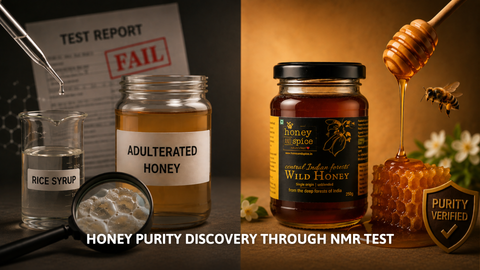
In late 2020, an investigative report by the Centre for Science and Environment (CSE) sent shockwaves through Indian kitchens. Major commercial honey brands long trusted as symbols of health and purity failed advanced international purity tests. The culprit? Highly sophisticated, invisible rice syrup engineered specifically to pass standard government testing. Today, as adulteration techniques become even more advanced, discerning between fake and real honey requires looking beyond glossy front labels and understanding the breakthrough science behind the honey adulteration NMR test.
Understanding how the honey adulteration NMR test technology works, keeping up with FSSAI honey standards, and examining a verified honey lab test report before purchasing are critical steps for any health-conscious household. In this comprehensive guide, we break down the science of modern honey testing, compare traditional screening methods with advanced nuclear magnetic resonance spectroscopy, and show you how to ensure 100% pure NMR-tested honey for your daily diet.
What is an NMR Test for Honey?
An NMR (Nuclear Magnetic Resonance) test for honey is an advanced analytical technique that acts like a digital "molecular fingerprint" scan of the honey matrix. By placing a sample under magnetic resonance, it simultaneously measures the unique spectroscopic signatures of every natural compound and sugar present. This enables food scientists to detect trace amounts of foreign added sugars, including hidden rice syrup and modified C3/C4 plant syrups, down to a precise 1% detection limit.
Experience 100% Uncompromised Purity
At Honey & Spice, we believe complete transparency is non-negotiable when it comes to your family's health. Explore our range of verified, single-origin NMR Tested Raw Honey harvested directly from pristine wild forests, completely unheated, untreated, and free from hidden syrups.

C3 C4 Test vs NMR Test For Honey: Understanding Adulteration Science
To understand why traditional quality checks fail to catch modern counterfeit honey, one must look at the evolution of adulteration science.
Historically, adulterators diluted pure honey with cheap sugar syrup derived from cane sugar or corn starch. To combat this, regulatory bodies relied on carbon isotope ratio mass spectrometry (C3/C4 testing)
- C4 Plant Sugars: Sugars derived from C4 plants (like sugarcane and corn) have a distinct carbon isotope ratio compared to nectar gathered by bees from C3 plants (most flowering plants and trees). The traditional C3/C4 test easily flags the addition of corn syrup or cane sugar.
- The Rise of Rice Syrup Adulteration: As C3/C4 testing became standard across international labs, industrial adulterators turned to C3 plant sources. Modern rice syrup adulteration involves using specially engineered, highly clarified syrups made from rice, wheat, or beet starch. Because rice is a C3 plant, its carbon isotope signature mimics natural floral nectar, allowing modified rice syrup to easily bypass standard C3/C4 isotopic analysis.
This gap in traditional testing was famously exposed when the Centre for Science and Environment published its landmark CSE honey report. The investigation revealed that major brands of commercial honey sold across India were passing routine C3/C4 lab tests while containing significant amounts of hidden C3 plant syrups engineered to dodge basic screening protocols.

Here’s how NMR testing is different from C3C4 testing
To defeat such sophisticated contamination, food scientists turned to Nuclear Magnetic Resonance (NMR) spectroscopy. Unlike isotopic ratio testing, which only measures specific carbon isotope values, an NMR test generates a complete, high-resolution spectroscopic profile, a digital "molecular fingerprint" of the entire honey matrix. By scanning the unique magnetic resonance of every compound present, NMR spectroscopy detects foreign syrups down to trace levels, regardless of whether they originate from C3 or C4 plants.
| Parameter / Feature | Traditional C3/C4 Carbon Isotope Test | Advanced NMR (Nuclear Magnetic Resonance) Test |
|---|---|---|
| Detection Scope | Detects C4 sugars (Cane sugar, Corn syrup) | Detects C4 and C3 sugars (Rice syrup, Beet syrup, Invert sugar) |
| Methodology | Carbon Isotope Ratio Mass Spectrometry | High-Field Magnetic Resonance "Fingerprint" Profiling |
| Resistance to Evasion | Low; easily bypassed by C3 rice syrups | High; scans full chemical composition simultaneously |
| Origin & Botanical Verification | Limited | Verifies floral species and geographical origin |
| Purity Guarantee | Partial | Comprehensive, gold-standard purity guarantee |

NMR Test Honey vs Normal Honey: Which Is Safer For Your Family?
When deciding between pure NMR test honey and unverified commercial honey, the health and safety implications for your family are substantial.
"Normal" or unverified market honey is frequently subjected to high-temperature thermal processing and ultra-filtration. Factories heat honey above 65°C to liquefy it quickly, strip out natural pollen (which prevents crystallisation), and mix in low-cost invert sugar syrup or rice liquid. This ultra-processing and thermal denaturation destroys live enzymes (such as diastase and glucose oxidase), strips away heat-sensitive antioxidants, and creates elevated levels of Hydroxymethylfurfural (HMF), a toxic byproduct formed when sugars are overheated.
In contrast, pure NMR test honey offers distinct safety and nutritional advantages:
- Zero Added Sugar Syrups: Guarantees that the bottle contains strictly bee-derived nectar with zero rice syrup adulteration, fructose feeds, or artificial invert sugars.
- Preserved Bioactive Nutrients: Authentic raw honey tested via NMR retains its natural trace elements (including iron, zinc, potassium, and magnesium), polyphenols, and active enzymes that support immune health.
- Absence of Synthetic Contaminants: NMR profiling screens for unexpected chemical markers, ensuring no synthetic additives or foreign adulterants degrade the natural matrix.
- Optimal Fructose-Glucose Balance: Natural honey possesses an ideal, balanced fructose-glucose ratio created naturally by honeybees. Artificial syrups distort this ratio, leading to rapid glycemic spikes upon consumption.
Feeding your family NMR-verified raw honey ensures they receive authentic antimicrobial and antioxidant superfood benefits rather than empty, ultra-processed calories.
How to Read an NMR Test Report For Honey Before Buying
Understanding how to evaluate an official honey lab test report empowers you to verify authenticity directly rather than relying on promotional front-of-pack claims.
When examining a lab certificate or checking a manufacturer's batch documentation, look for key testing parameters defined by international protocols and updated FSSAI honey standards:
Key Parameters to Inspect on a Honey Lab Test Report
- NMR Spectroscopic Profile (Pass/Fail): The report should explicitly state that the sample matches the global reference database for authentic, unadulterated honey and exhibits no signals corresponding to foreign polysaccharides or C3/C4 syrups.
- Fructose Glucose Ratio: Pure honey naturally consists predominantly of fructose (approx. 38–44%) and glucose (approx. 30–35%). The combined total of fructose and glucose must exceed 60 g/100g according to standard regulations. A healthy fructose-glucose ratio typically ranges between 0.9 and 1.4, depending on the floral source. Significant deviations often indicate dilution with high-fructose or high-glucose syrups.
- Sucrose Content: Natural floral honey contains very low amounts of sucrose (typically under 5%). Elevated sucrose readings indicate that bees were fed sugarcane syrup or that sugar syrup was added directly post-harvest.
- Specific Marker Compounds (e.g., SMR / Rice Syrup Markers): Advanced reports specifically search for marker compounds unique to industrial starch hydrolysis (such as Special Marker for Rice syrup or SMR). A negative result confirms freedom from rice syrup adulteration.
- Electrical Conductivity & Trace Elements: Conductance reflects the concentration of natural minerals, organic acids, and trace elements. Darker forest honeys naturally display higher electrical conductivity due to their mineral density.
- Diastase Activity & HMF (Hydroxymethylfurfural): Diastase is a heat-sensitive natural enzyme introduced by bees. High diastase activity combined with low HMF levels proves the honey is raw, fresh, and unheated.

Why You Should Only Add NMR-Tested Raw Honey to Your Daily Diet
Incorporating authentic raw honey into your daily wellness routine, whether in morning warm water, herbal teas, or wellness remedies, delivers profound therapeutic rewards. However, these benefits depend entirely on the honey's purity.
Consuming fake or diluted commercial honey means regularly ingesting hidden high-glycemic syrups that cause sharp blood sugar spikes, contribute to metabolic stress, and lack essential micronutrients. The findings highlighted in the CSE Honey Report underscored how widespread rice syrup adulteration had become in everyday household brands.
By insisting on an authentic honey adulteration NMR test certification, you ensure that every spoonful delivers:
- Natural Antibacterial Power: Active glucose oxidase enzymes produce low-dose, therapeutic hydrogen peroxide, providing natural throat-soothing and digestive support.
- Antioxidant & Micronutrient Density: Unadulterated raw honey contains native pollen grains, bioflavonoids, and organic trace elements that fight oxidative stress and cellular ageing.
- Metabolic Support: The complex matrix of natural sugars in pure honey is metabolised more gradually than refined sucrose or industrial sugar syrup, offering sustained energy without rapid insulin crashes.
- Complete Peace of Mind: An NMR-backed purity guarantee eliminates guesswork, ensuring your investment in wellness yields real, uncompromised nutrition.

Summary Checklist: Navigating Fake vs Real Honey
When purchasing honey for your home, use this quick checklist to ensure maximum quality:
- Demand NMR Certification: Look for brands that offer batch-wise pure NMR test honey credentials verified by independent laboratory analysis.
- Review the Ingredient List: Ensure the label lists only one ingredient: 100% Pure Raw Honey. Reject any product mentioning added sugars, syrups, or preservatives.
- Check Compliance with FSSAI Honey Standards: Verify that the brand meets or exceeds national regulatory parameters for moisture, sucrose, diastase, and isotopic purity.
- Embrace Natural Crystallisation: Do not mistake crystallisation for fake honey. Real, raw, unheated honey naturally crystallises over time as glucose molecules separate from water; this is proof of raw purity, not spoilage!
- Inspect the Honey Lab Test Report: Confirm that key testing parameters, including the fructose glucose ratio, SMR markers, and diastase activity, fall strictly within authentic natural ranges.
FAQs
Q1. What is an NMR test for honey?
An NMR (Nuclear Magnetic Resonance) test is an advanced scientific scan that checks the complete molecular fingerprint of honey to detect hidden adulterants, foreign sugars, and modified syrups down to a 1% detection limit.
Q2. How can you tell the difference between fake and real honey?
While traditional home tests exist, the only scientifically proven way to verify 100% pure honey and detect sophisticated artificial syrups is through an official NMR lab test report. Fake honey often undergoes high-heat processing and lacks natural pollen.
Q3. Is the NMR test better than the C3 and C4 honey test?
Yes, traditional C3/C4 tests can be easily bypassed by adulterators using C3 plant syrups like rice or beet syrup. NMR testing provides a comprehensive chemical profile that easily spots these hidden syrups, making it far superior.
Q4. Does pure raw honey ever expire?
No, 100% authentic raw honey does not expire. Its natural acidity and low moisture content create an environment where bacteria cannot survive, allowing it to remain safe for consumption indefinitely if stored properly.
Q5. Does crystallized honey mean it is fake?
Not at all. Natural crystallisation is a sign of pure, raw, unheated honey. It happens naturally as glucose molecules separate from water over time, proving the honey retains its raw properties.
Q6. Can the NMR test detect rice syrup in honey?
Absolutely. The NMR test is specifically designed to detect traces of foreign added sugars, including highly clarified and engineered rice syrups that are purposely made to bypass standard government testing.
Q7. How do I read an NMR honey test report?
You should look for a "Non-Adulteration" or "Pass" status on the NMR spectroscopic profile, check for an authentic fructose-glucose ratio, and ensure specific marker compounds for rice syrup (like SMR) are completely absent.