Skip to content

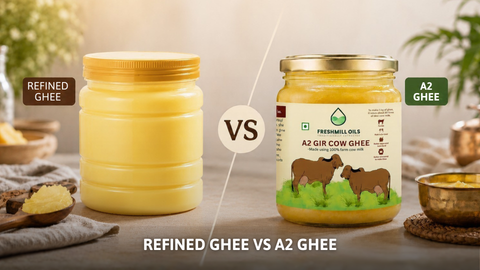
In traditional Indian kitchens, ghee has long been regarded as liquid gold. However, with modern processing techniques and growing health awareness, consumers are increasingly questioning what goes onto their plates. When browsing dairy aisles today, you will likely encounter various labels: commercial ghee, refined ghee, regular cow ghee, and traditional A2 Bilona ghee.
Understanding the debate between refined ghee vs A2 ghee is essential if you want to optimise your family’s nutrition with healthy dietary fats. This comprehensive guide explains the exact difference between normal ghee and A2 ghee, the traditional Bilona churning process, and why upgrading your pantry is worth it.
What is A2 Ghee?
To understand the core debate surrounding A2 ghee vs regular ghee, we must start with the milk source.
So, what is A2 ghee?
A2 ghee is clarified butter produced exclusively from the milk of indigenous (desi) cow breeds such as Gir, Sahiwal, Kankrej, and Red Sindhi. These native Indian cows naturally yield milk containing only the A2 beta-casein protein.
In contrast, when analysing normal ghee vs A2 cow ghee, regular or commercial ghee is typically derived from crossbred, hybrid, or exotic cow breeds (like Holstein Friesian and Jersey) or buffalo milk, which primarily contains the A1 beta-casein protein. When digested, A1 protein releases a peptide called beta-casomorphin-7 (BCM-7), which has been linked to stomach discomfort, inflammation, and bloating in sensitive individuals. A2 milk lacks this peptide, making A2 cow ghee significantly gentler on the digestive tract
Key Differences: Refined Ghee vs A2 Ghee
To make an informed purchasing decision, it helps to examine the fundamental contrasts in the difference between normal ghee and A2 ghee:
| Feature | Refined / Normal Ghee | A2 Cow Ghee |
|---|---|---|
| Milk Source | A1 protein milk from hybrid/exotic cows or mixed breeds | Pure A2 milk from native, indigenous Indian cows |
| Production Method | Industrial cream separation and high-heat boiling | Traditional two-way churning (Bilona method) |
| Digestibility | Can cause bloating or discomfort due to A1 protein | Easy to digest, lactose-friendly, and light on the gut |
| Nutrient Density | Lower retainment of enzymes and vitamins | High concentration of Omega-3s, butyric acid, & vitamins A, D, E, K |
| Aroma & Texture | Flat aroma, smooth or artificially stabilized texture | Rich, nutty aroma with a natural grainy (Danedar) texture |
| Smoke Point | Standard smoke point (~200°C–230°C) | Superior a2 ghee smoke point (~250°C / 482°F) |

The Ancient Bilona Churning Method: A Step-by-Step Deep Dive
The true essence of traditional A2 ghee lies in the centuries-old Vedic Bilona method. Unlike industrial shortcut techniques, the Bilona method is a slow, artisanal process that transforms whole cultured curd into golden, nutrient-rich ghee.
Here is how the traditional 5-step Bilona churning process works:
-
Step 1: Gentle Boiling of Pure A2 Milk
Freshly milked A2 milk from grass-fed indigenous cows is boiled slowly over a low fire in earthen or heavy-bottomed vessels. Gentle boiling ensures that delicate vitamins and proteins remain intact without scorching. -
Step 2: Natural Curdling
Instead of extracting cream mechanically, the warm milk is inoculated with a natural starter culture (dahi) and left to ferment overnight into whole curd. This crucial fermentation stage breaks down lactose and synthesises beneficial gut-friendly organic acids and probiotics. -
Step 3: Bi-Directional Wooden Churning (The Bilona Step)
The whole curd is transferred into a deep vessel and churned using a wooden churner called a Valona or Bilona. The churning is done in two opposite directions (clockwise and counterclockwise). This bi-directional motion gently separates butterfat from the cultured buttermilk without overheating the fats. -
Step 4: Separating Fresh Butter (Makhan)
As churning continues, fresh cultured butter (Makhan) rises to the top. This butter is carefully skimmed off by hand, separating it from the nutrient-dense leftover buttermilk (Chaach). -
Step 5: Slow Heating & Clarification
The cultured Makhan is heated slowly on a mild flame. As the moisture evaporates and milk solids settle at the bottom, a golden, highly aromatic liquid emerges. The clarified fat is strained to yield pure, grainy A2 Bilona ghee.
When evaluating bilona ghee vs normal ghee, this traditional churning method preserves volatile aromatic compounds, essential fatty acids, and heat-sensitive antioxidants that industrial methods lose.

Commercial Ghee vs Bilona Ghee: Why Processing Matters
Understanding commercial ghee vs bilona ghee comes down to speed versus quality.
- Commercial / Regular Ghee Process: Large-scale dairy factories bypass the culturing and curdling steps completely. Industrial separators extract raw cream directly from milk at high speeds. This cream is then boiled rapidly at extreme temperatures to yield ghee in a fraction of the time. Some refined commercial versions are further subjected to chemical processing, bleaching, or deodorisation to homogenise shelf-life and appearance.
- Bilona Ghee Process: As detailed above, Bilona ghee uses whole cultured curd and traditional hand-churning. This method retains short-chain fatty acids, natural carotene, and a distinct, grainy (Danedar) texture with a deep, toasted nutty aroma.
Is A2 Ghee Better Than Normal Ghee?
Health-conscious individuals frequently ask: Is A2 ghee better than normal ghee?
The short answer is yes. Here are the primary benefits of replacing normal ghee with a2 ghee in your daily diet:
- Enhanced Gut Health & Metabolism: A2 ghee is packed with butyric acid, a short-chain fatty acid that nourishes intestinal walls, reduces internal inflammation, and aids digestion.
- Superior Fatty Acid Profile: As one of the finest sources of healthy dietary fats, A2 ghee offers an optimal ratio of Omega-3 to Omega-6 fatty acids, supporting heart health and cholesterol balance.
- Better Nutrient Absorption: Fat-soluble vitamins (A, D, E, and K) present in A2 ghee require quality healthy fats for absorption. Including A2 ghee in daily meals improves nutrient bioavailability.
- Lactose & Casein Friendly: Because milk solids are removed during slow heating, and the milk source is pure.
Why A2 Ghee is Expensive
A common observation among shoppers evaluating A2 ghee vs regular ghee is the price gap. Understanding why A2 ghee is expensive requires looking at yield and production effort:
- Low Milk Yield of Desi Cows: Indigenous Indian cow breeds yield only about 6 to 10 litres of milk per day, whereas hybrid A1 cows produce 20 to 30+ litres daily.
- High Milk Requirement: It requires approximately 25 to 30 litres of pure A2 milk to produce just 1 litre of traditional Bilona ghee.
- Labour-Intensive Process: Making Bilona ghee involves hand-churning, slow heating, and natural culturing, which demands significant time and manual craftsmanship compared to automated industrial plant production.
- Ethical & Grass-Fed Farming: Authentic A2 ghee comes from ethically raised, free-grazing cows that are not injected with synthetic growth hormones or antibiotics.

The Best Ghee for Indian Cooking & Smoke Point Advantage
Indian cuisine relies heavily on high-heat techniques, including deep frying, tempering (tadka), roasting, and sautéing. Selecting the best ghee for indian cooking depends largely on thermal stability.
The a2 ghee smoke point sits exceptionally high at approximately 250°C (482°F).
Why does this matter? When cooking oils or fats reach their smoke point, they oxidise, break down, and generate harmful free radicals and acrolein. Due to its high a2 ghee smoke point and pure saturated fat structure, A2 ghee remains stable under intense thermal stress, ensuring that your meals retain both flavour and nutritional integrity without releasing toxic fumes
 How to Identify Pure A2 Ghee at Home
With many brands claiming to offer authentic products, knowing how to identify pure A2 ghee ensures you receive true quality:
- The Palm Test: Place a small spoon of A2 ghee on your palm. Pure A2 ghee melts naturally at human body temperature (~37°C / 98.6°F) within seconds.
- Granular (Danedar) Texture: Genuine Bilona A2 ghee has a naturally distinct, grainy texture rather than an artificially smooth or greasy feel.
- Rich Nutty Aroma: Pure A2 ghee possesses a deep, pleasing, traditional nutty aroma that persists when added to hot food.
- Heating Test: Heat a spoonful of ghee in a pan. If it melts instantly and turns a rich brownish-golden colour, it is pure. If it takes a long time to melt and turns pale yellow, it may be diluted with vegetable oils or palm fat.
Conclusion
When choosing between refined ghee vs A2 ghee, the distinction extends far beyond simple marketing. While regular commercial ghee offers convenience, traditional A2 Bilona ghee delivers unmatched purity, superior digestion, higher nutrient density, and rich, authentic taste.
By understanding what is a2 ghee, mastering the nuances of the bilona churning method, and recognising why A2 ghee is expensive, you can make a conscious shift toward superior, healthy dietary fats. For daily culinary needs, tempering, and wellness, A2 Bilona ghee stands out as the ultimate best ghee for indian cooking.
FAQs
Q1. What is the main difference between A2 ghee and regular ghee?
The main difference lies in the milk source. A2 ghee is made from the milk of indigenous cows containing only the A2 protein, while regular ghee comes from crossbred cows or buffaloes that produce milk with the A1 protein.
Q2. Why is A2 Bilona ghee considered healthier?
It is made using a traditional slow-churning process from cultured curd, which preserves beneficial short-chain fatty acids, antioxidants, and a higher nutritional value compared to industrially processed commercial ghee.
Q3. Is A2 ghee safe for lactose intolerant individuals?
Yes, the slow clarification process removes milk solids, making pure A2 ghee virtually free of lactose and casein, which is generally well-tolerated by sensitive stomachs.
Q4. Why does A2 ghee cost more than regular ghee?
Native Indian cows yield less milk than hybrid breeds, and it takes around 25 to 30 liters of A2 milk to make just one liter of Bilona ghee. The labor-intensive hand-churning process also adds to the overall production cost.
Q5. Can I use A2 ghee for deep frying?
Absolutely. A2 ghee has a very high smoke point of around 250°C (482°F), making it highly stable and excellent for deep frying, sautéing, and heavy Indian cooking without releasing toxic fumes.
Q6. How can I test the purity of A2 ghee at home?
You can place a spoonful of ghee in a hot pan. Pure A2 ghee will melt instantly and turn a golden-brown color, whereas impure ghee may take longer to melt and appear pale yellow.
Q7. Does A2 ghee expire quickly?
When stored properly in a cool, dark place away from moisture, authentic A2 ghee has a very long shelf life. Its natural saturated fats make it highly resistant to rancidity.